Dockerized libRadtran and SMARTS for radiative transfer
April 8, 2026
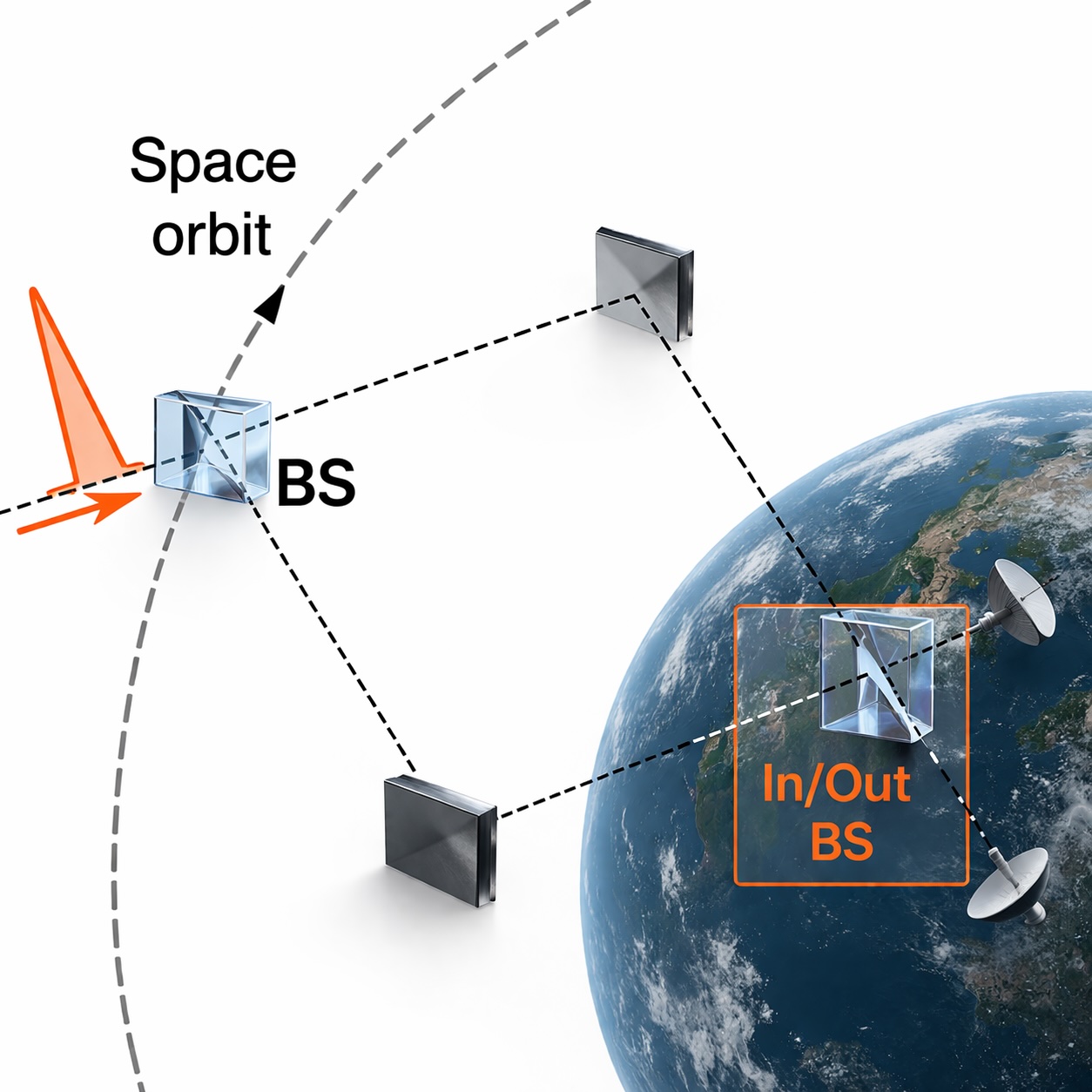
Researchers have sent entangled single photons over very long distances to conduct some impressive experiments, typically to explore the non-local nature of quantum mechanics. The world’s biggest delayed-choice quantum eraser experiment (Ma et al., 2013) sent entangled photons 144 km between two of the Canary Islands. While a version of Wheeler’s delayed-choice experiment sent entangled photons to LEO and back. (Vedovato et al., 2017).
Atmospheric transmission
There are multiple forms of analysis required to build out a link budget for such an effort. One important component is the fraction of your photons that will scatter or be absorbed in the atmosphere. I’ve recently been doing this sort of analysis, and tried it a few ways. It’s straightforward to compute a rough transmission estimate by building an ad-hoc model of the effects of Rayleigh scattering, the aerosol and molecular content of the air (water, oxygen), clouds, etc.
Radiative transfer tools
A more reliable and comprehensive approach is to use an existing software package designed to model radiative transfer. This has the advantage of being well researched and battle-tested by academic or commercial authors with deep knowledge.
The most noteworthy relevant tools are:
- MODTRAN — A commercial radiative transfer model widely used in industry and government for transmission, emission, and scattering calculations. (Berk et al., 2014)
- libRadtran — A more flexible, general-purpose open-source toolkit for atmospheric radiative transfer calculations. (Mayer & Kylling, 2005; Emde et al., 2016)
- SMARTS — A fast clear-sky radiative transfer model focused on spectral irradiance at Earth’s surface. (Gueymard, 1995)
Docker images
MODTRAN is a commercial package, while libRadtran and SMARTS are freely available. The free tools are both based on FORTRAN scientific code bases, and aren’t what you might call “easy to install”.
I spent a few hours bashing them into Docker containers and published the recipes to GitHub. Hopefully this saves others some time and frustration in the future.
References
- Ma, X.-S., Kofler, J., Qarry, A., Tetik, N., Scheidl, T., Ursin, R., Ramelow, S., Herbst, T., Ratschbacher, L., Fedrizzi, A., Jennewein, T., & Zeilinger, A. (2013). Quantum erasure with causally disconnected choice. Proceedings of the National Academy of Sciences, 110(4), 1221–1226. https://doi.org/10.1073/pnas.1213201110
- Vedovato, F., Agnesi, C., Schiavon, M., Dequal, D., Calderaro, L., Tomasin, M., Marangon, D. G., Stanco, A., Luceri, V., Bianco, G., Vallone, G., & Villoresi, P. (2017). Extending Wheeler’s delayed-choice experiment to space. Science Advances, 3(10), e1701180. https://doi.org/10.1126/sciadv.1701180
- Berk, A., Conforti, P., Kennett, R., Perkins, T., Hawes, F., & van den Bosch, J. (2014). MODTRAN6: a major upgrade of the MODTRAN radiative transfer code. Algorithms and Technologies for Multispectral, Hyperspectral, and Ultraspectral Imagery XX, 9088, 90880H. https://doi.org/10.1117/12.2050433
- Mayer, B., & Kylling, A. (2005). Technical note: The libRadtran software package for radiative transfer calculations - description and examples of use. Atmospheric Chemistry and Physics, 5(7), 1855–1877. https://doi.org/10.5194/acp-5-1855-2005
- Emde, C., Buras-Schnell, R., Kylling, A., Mayer, B., Gasteiger, J., Hamann, U., Kylling, J., Richter, B., Pause, C., Dowling, T., & Bugliaro, L. (2016). The libRadtran software package for radiative transfer calculations (version 2.0.1). Geoscientific Model Development, 9(5), 1647–1672. https://doi.org/10.5194/gmd-9-1647-2016
- Gueymard, C. A. (1995). SMARTS2: A Simple Model of the Atmospheric Radiative Transfer of Sunshine: Algorithms and Performance Assessment (No. FSEC-PF-270-95; Issue FSEC-PF-270-95). Florida Solar Energy Center, University of Central Florida.